Digitalizing chemical management: from a folder to a system that tracks change
27/09/2026 | By Ivan Milenković
Digitalizing chemical management rarely starts with software. It starts with one uncomfortable question: how fast can we come back into compliance when a regulation changes? Not whether we’re compliant today, but whether we’ll still be compliant tomorrow.
This piece grew out of the second block of the training “Chemical management in Serbia: from legal obligations to a digital system,” which I ran on September 10, organized by the Balkan Council for Sustainable Development and Education. The first block covered the obligations. The second covered how to actually meet them.
Compliance is a process, not a state
Serbia’s Chemicals Act and its bylaws give a clear framework. The problem comes afterward. Substance lists get updated, classifications change, and new restrictions arrive periodically. A company that was compliant last year can have an invalid safety data sheet today, without anyone noticing.
In practice, the job of tracking these changes usually falls on an in-house chemical advisor — and it’s often an extra task on top of their regular job. Changes then get tracked late, or not at all.
The consequences show up on the ground:
- old-format safety data sheets are still in circulation,
- substance classification isn’t aligned with the SKS list (Serbia’s national chemical classification list),
- a product’s classification doesn’t match its actual composition,
- labels are missing required elements or don’t match the safety data sheet,
- incompatible chemicals are stored together.
When regulation isn’t tracked continuously, changes slip by unnoticed and the risk sits with the company. For a long time that risk rarely materialized, because enforcement was weak and compliance was low on the priority list. That didn’t mean the risk wasn’t there — it just hadn’t been called in yet.
Two tracks: the national and the EU framework
Companies doing business with the EU market work on two tracks at once. The same product needs to be compliant on both, on different timelines.
On the EU track, changes come from two sources. The first is amendments to the REACH regulation and its annexes (XIV, XVII, the SVHC list). These later get carried into Serbian bylaws and can bring a new safety data sheet format, new restrictions or bans. The second is the ATPs — the regular amendments to the CLP regulation that add new hazard classes and change the harmonized classification in Annex VI.
The national track follows the EU, but with a delay. The SKS list picks up changes from Annex VI, and every such change is a potential reclassification for a product in your portfolio.
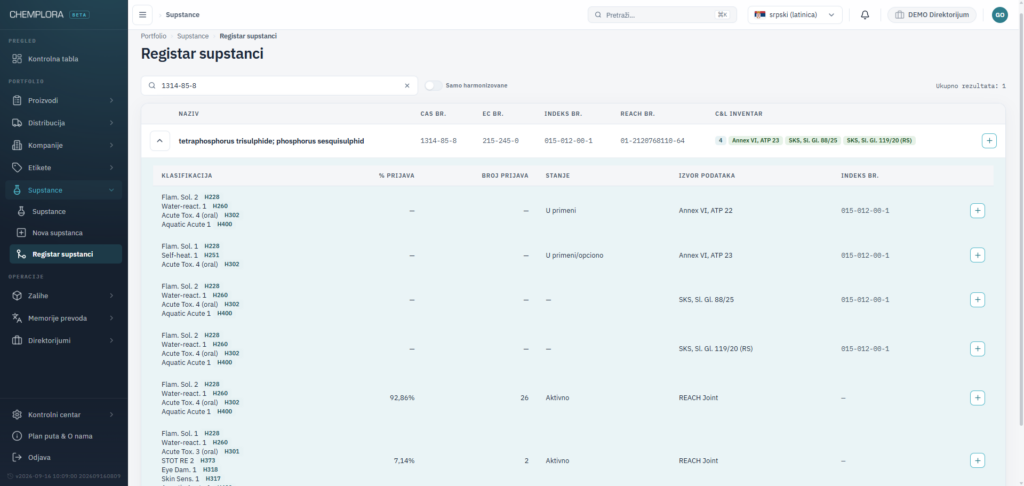
What that looks like for one specific substance is shown in the screenshot below. For the same substance, the registry holds classifications from ATP 22, ATP 23, the current SKS list (“Official Gazette of RS,” no. 88/25) and the REACH registration. ATP 23 gives a different classification than the one currently in the SKS list. For a company that exports, that means two different classifications of the same substance at the same time, depending on the market.
Checking against restriction lists
Every change raises the same question: is my product affected? The check doesn’t stop at classification. A product also needs to be checked against restriction lists:
- restrictions and bans (the Rulebook on Restrictions and Bans, “Official Gazette of RS,” no. 90/25 and 28/26),
- the list of substances of concern and the SKIZ candidate list,
- the Rotterdam Convention — the Prior Informed Consent (PIC) procedure,
- the Stockholm Convention on Persistent Organic Pollutants (POPs).
A single substance can be on several of these lists at once, on both tracks. Manually checking an entire portfolio after every change takes more time than most people have.
The same applies to information that doesn’t show up on any restriction list. Since the latest amendment to the Rulebook on Safety Data Sheet Content (11/24), an SDS must include data on substances with endocrine-disrupting properties: in subsection 2.3 for substances present at 0.1% or more, and in subsections 11.2 and 12.6 for their health and environmental effects. How that check is actually done is a topic for its own article.
Importers and exporters see the same problem from two sides
Importers usually receive a safety data sheet from a foreign supplier. A common mistake is to simply translate that sheet. A translation keeps the foreign references, the foreign exposure limits and the substance classification without checking any of them. Bringing it into compliance means checking the classification against the SKS list and against Serbian regulation. Responsibility for the accuracy of the sheet lies with whoever places the product on the market, not with the foreign supplier.
Exporters face the opposite direction. Does the safety data sheet meet REACH and CLP requirements? Is it in the language of the destination market? Does the label carry a supplier established in the EU, as the revised CLP regulation (Regulation (EU) 2024/2865) requires? And does the label match the safety data sheet? A mismatch between label and SDS is a common finding, and a serious risk on export.
Public data goes stale too
Part of the obligation isn’t in a folder — it’s on the internet. The composition of detergents must be published on a website, per the Rulebook on Detergents. Advertising hazardous chemicals requires that the buyer be informed of the hazard before purchase.
When a classification changes, the published data has to change with it. Which is exactly why it usually doesn’t:
- the data is locked in static .docx and .pdf files, scattered across computers,
- every change to a formulation or to the SKS list requires manually editing every product page,
- stale data on a website is publicly visible — to inspectors and to competitors alike.
The problem isn’t a lack of good intentions. It’s a lack of a system.
Four pillars of a digital system
A chemical management system needs to keep four things under control, all from one source of data.
Chemical inventory
The inventory is the foundation for everything else. A complete inventory covers product identification, hazard identification, location, quantity, and a link to the safety data sheet. It follows the company’s organizational structure, consumption and minimum stock levels. Without an accurate inventory, every other check rests on an assumption.
Safety data sheet management
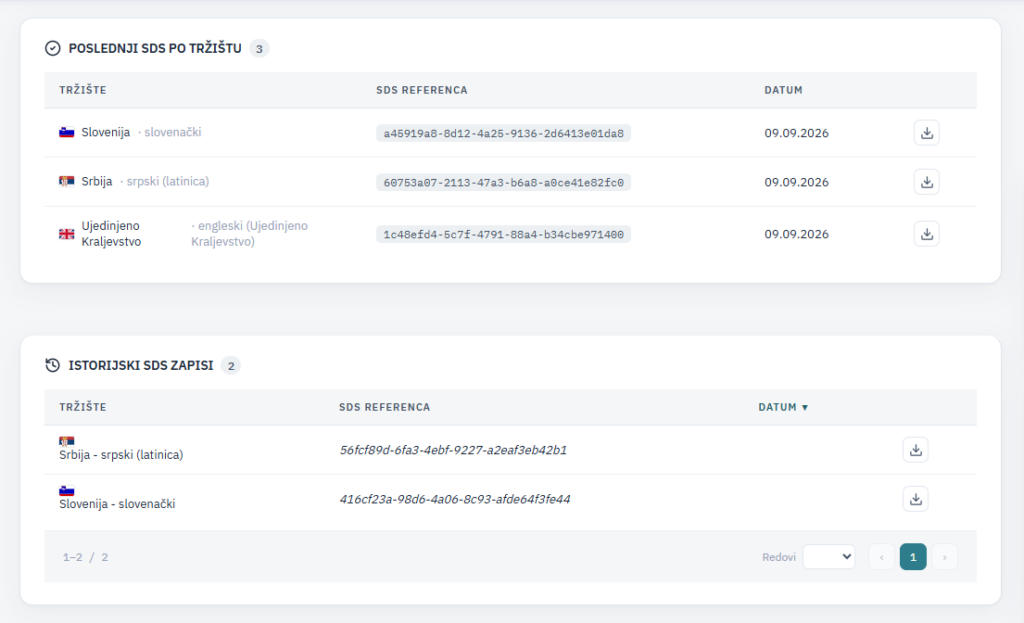
A central library holds every version, with dates and revisions. Each sheet is linked to a product in the inventory. The system tracks update deadlines and enables distribution to customers and employees, as well as fast access during a regulatory inspection. For companies selling into multiple markets, it matters that you can see, in one place, the latest version for each market and language, along with the history of previous versions.
Tracking classification changes
This is the pillar that manual work handles worst. The chain looks like this: substance, classification, product, safety data sheet, label, publication. When a substance’s classification changes, the system should flag every product that contains it. Instead of you chasing the change, the change finds you.
Digitalizing processes and storage
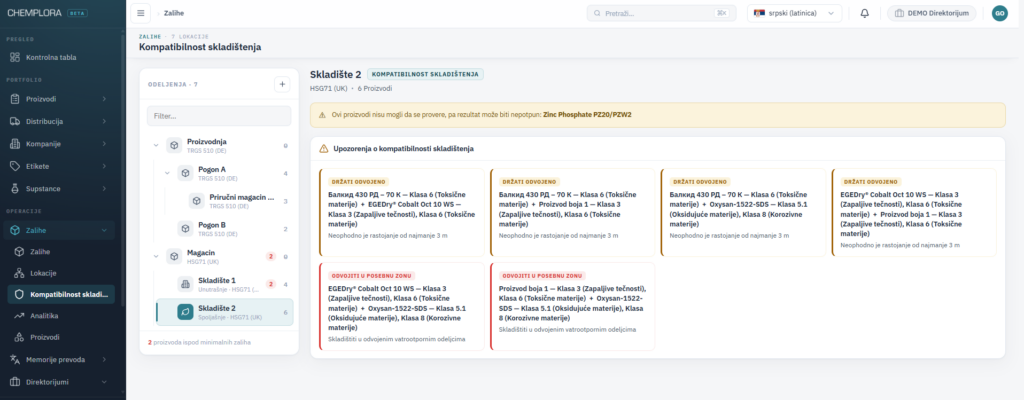
The fourth pillar turns data into procedures. Storage compatibility is a good example. Rules about what can be stored together (for example, the TRGS 510 principles) can live as paper on a warehouse wall. Or they can be data the system checks for every location, flagging it when incompatible chemicals end up in the same space.
One source of data, many outputs
When data is connected in one place, everything else follows from it: change notifications, reports, web publications, an audit trail, and ERP integration. The same source feeds PCN filings, the digital product passport and the digital label.
That’s the exact principle we’re building Chemplora on. The screenshots in this piece are from the system: a substance registry with classifications from both tracks, safety data sheets by market, and storage-compatibility checks by location. The goal isn’t another database — it’s making sure data about substances, products, sheets and locations is connected, so a single change doesn’t have to be manually carried over to ten different places.
The bigger wave: the EU wants machine-readable data
All of this matters even more with the Digital Product Passport (DPP), introduced through the ESPR regulation (Regulation (EU) 2024/1781). A PDF document is no longer enough there — the requirement is structured, machine-readable data, accessible via a QR code on the packaging.
Detergents are the first chemical category affected. Under Regulation (EU) 2026/405, from September 23, 2029, detergents and surfactants sold in the EU must have a DPP. For exporters from Serbia, that also means engaging an authorized representative in the EU. The European Commission’s central DPP registry went live in July 2026, so companies can already start testing their setups.
Serbia’s own framework is moving too. The working draft of the new Chemicals Act includes a digital label as an optional feature. Whoever gets their data in order now will be ready when it’s not optional anymore.
A practical path to digitalization
Digitalization doesn’t have to start as a big project. In practice, this order tends to work best:
- An accurate inventory. You can start without software. What matters is that it reflects reality.
- A safety data sheet library. Every version in one place, with clear dates.
- Linking it all together. Products, substances, sheets and labels as one connected whole.
- Automation. Change notifications and web publications generated from the same data.
Software is just the accelerator. Clean data is the foundation.
Frequently asked questions
What does digitalizing chemical management mean? It means moving from data scattered across Word, Excel and PDF files into one connected system, where the chemical inventory, safety data sheets, classifications and locations are linked — so a change in one place shows up everywhere it matters.
How often does the SKS list change? Serbia’s SKS list (the national chemical classification list) is updated periodically — twice in 2025 — picking up changes from the EU’s harmonized classification (the ATPs) with a delay. The list currently in force was published in the “Official Gazette of RS,” no. 88/25, and applies from July 1, 2026.
Is it enough to translate a foreign supplier’s safety data sheet? No. The SDS has to be brought into compliance with Serbian regulation, including checking the substance classification against the SKS list. Responsibility for accuracy lies with whoever places the product on the Serbian market.
Since when is the digital product passport mandatory for detergents? Under Regulation (EU) 2026/405, from September 23, 2029, for detergents and surfactants sold in the EU.
Do you need software to get started? No. The first step is an accurate chemical inventory, which you can build without any software. Software starts to matter once you need to link the data together and track changes across multiple places at once.
If you’d like to see what this approach looks like applied to your own portfolio, reach out at savetnik@vetren.rs for a walkthrough of the system.
References:
- Chemplora platform
- Regulation (EU) 2026/405 on detergents and surfactants
- ESPR regulation (Regulation (EU) 2024/1781)
- From substance to product, the full compliance network
- The EU digital product passport registry has launched
- “Digital Product Passport” for chemical products: deadlines, requirements and preparation
- Common Data Platform on Chemicals: the EU builds a unified chemicals database
- Digital chemical passport and trade secrets: who sees what?
This blog post is for informational purposes only and does not constitute legal advice. For specific situations, consult a licensed chemical adviser or a lawyer specialising in chemical regulation.
← Back to blog