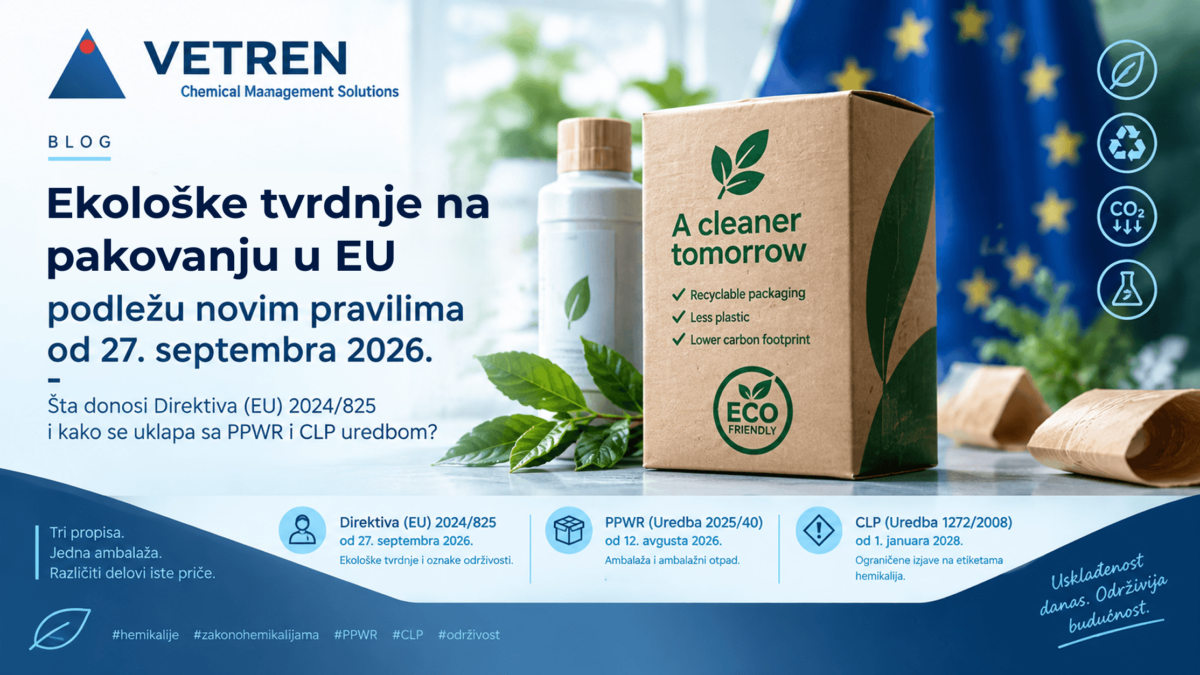
Green claims on packaging: the EU's new rules apply from September 27, 2026
20/09/2026 | By Ivan Milenković
Green claims on packaging become subject to Directive (EU) 2024/825 on empowering consumers for the green transition, starting September 27, 2026. The directive itself isn’t new — it was adopted back in 2024. What starts now is its application. It bans generic environmental claims made without evidence, as well as sustainability labels not based on a certification scheme.
The deadline lines up with two other packaging-related regulations. The Packaging and Packaging Waste Regulation (PPWR) has applied since August 12, 2026. The CLP regulation, meanwhile, has long restricted statements on chemical labels. Each of these three regulations governs a different part of the same package.
Directive 2024/825 only applies to sales to consumers (B2C). The CLP regulation and the PPWR apply regardless of who the buyer is. If you sell exclusively to other businesses, the Directive doesn’t apply to you directly — but CLP and PPWR still do.
Green claims on packaging: practices banned under Directive 2024/825
The directive amends two older pieces of legislation: the Unfair Commercial Practices Directive (2005/29/EC) and the Consumer Rights Directive (2011/83/EU). It was adopted on February 28, 2024. Member states had to transpose it into national law by March 27, 2026. It applies from September 27, 2026.
The directive only covers business practices directed at consumers (B2C). It doesn’t regulate what kind of product may be sold — it regulates how the product is presented to the consumer.
The new prohibitions are written into Annex I of Directive 2005/29/EC — the list of practices considered unfair under all circumstances. Four of them matter most for packaging:
- point 2a: a sustainability label not based on a certification scheme, and not established by public authorities;
- point 4a: a generic environmental claim made without evidence of recognized excellent environmental performance relevant to the claim;
- point 4b: a claim about the whole product or the whole business, when it actually concerns only one aspect;
- point 4c: a claim of neutral, reduced or positive impact on greenhouse gas emissions, based on emissions offsetting.
Generic claims and the exception for precise statements
The directive’s recitals list examples of generic claims, including “environmentally friendly,” “green,” “eco,” “climate friendly,” “energy efficient,” “biodegradable” and “bio-based.” A claim like this is banned if the trader can’t prove recognized excellent environmental performance relevant to that specific claim.
There’s an exception that matters for packaging: a claim isn’t treated as generic if it’s clearly and visibly qualified on the same medium — for example, on the same packaging. So it’s better to state a specific, provable property than to just use the word “eco.”
Recognized excellent performance can be demonstrated, for example, by the EU Ecolabel or a Type I scheme under EN ISO 14024. And the environmental claim doesn’t stop at the text — the Commission’s updated guidance also looks at claims embedded in a brand, product or company name.
Old stock: packaging produced before September 27
Many manufacturers already have packaging printed with claims on it. The network of national consumer protection authorities (the CPC network) adopted a Common Position on “old stock” on June 30, 2026. It covers products and packaging carrying environmental claims or sustainability labels that were manufactured, ordered, distributed or placed on shelves before September 27, 2026.
The document isn’t a legally binding interpretation of the directive. Its first principle states that old stock does not exempt traders from the obligation to comply. The Commission did not provide for a transition period, though the network does allow for a gradual approach to enforcement where genuine, concrete transitional difficulties exist.
Which is why an inventory of the claims on your existing packaging should start now.
Where PPWR and CLP overlap
Directive 2024/825 governs how a product is presented to the consumer. The other two regulations govern the packaging itself.
The PPWR, Regulation (EU) 2025/40, has applied since August 12, 2026. Article 5(4) caps the combined amount of lead, cadmium, mercury and hexavalent chromium at 100 mg/kg in packaging. Article 5(5) sets limits for PFAS in packaging that comes into contact with food: 25 ppb for an individual PFAS, 250 ppb for the sum, and 50 ppm for PFAS including polymeric ones. The manufacturer must carry out a conformity assessment, compile technical documentation and issue an EU declaration of conformity (Articles 38 and 39). The importer then checks that this has been done.
There’s a connection to Directive 2024/825 around claims about packaging composition. Point 10a of Annex I bans a specific practice: a trader may not present a requirement that the law already imposes on an entire product category as a distinguishing feature of their own offer. The PPWR imposes heavy-metal limits on all packaging, so touting packaging as “heavy-metal free” as a selling point can fall under this provision. Whether it does depends on how the claim is worded and how broad the legal limit is — worth checking before the claim stays on the packaging.
The CLP regulation has its own rule. Article 25(4) lists statements such as “non-toxic,” “eco-friendly,” “non-polluting” and “green.” These may not appear on the label or packaging of a substance or mixture — nor may any statement suggesting the substance or mixture is not hazardous, or that is inconsistent with its classification. This article applies to every substance and mixture, with no B2C limitation.
The revised CLP regulation (EU) 2024/2865 entered into force on December 10, 2024. Its advertising provisions apply from January 1, 2028, under Regulation (EU) 2025/2439.
An inventory of environmental claims, by September 27
A practical sequence:
- List every claim on packaging, labels, your website, catalogs and ads.
- For each claim, pin down the specific product property it refers to.
- Gather evidence for that property: a test report, a supplier statement, or a certificate.
- Cross-check the claim against the product’s classification and safety data sheet.
- Record who owns the data and who signs off on the claim.
- If the product reaches EU consumers through a retailer, agree with them on which claims stay.
This piece covers the EU rules. Serbian law is out of scope here and should be checked separately for the domestic market.
Frequently asked questions
Since when does Directive 2024/825 apply?
It applies from September 27, 2026. Member states had to transpose it into national law by March 27, 2026.
Does the directive apply to B2B sales?
No — it only covers business practices directed at consumers. Articles 5(4) and 5(5) of the PPWR and Article 25(4) of the CLP regulation, however, apply regardless of who the buyer is.
Is the word “eco” banned?
Under the directive, a generic claim is banned unless recognized excellent environmental performance can be proven. The exception is a claim that is clearly and visibly qualified on the same medium. CLP Article 25(4) separately lists “eco-friendly” among the statements that may not appear on the label or packaging of a substance or mixture.
What counts as “old stock”?
Products or packaging carrying environmental claims or sustainability labels that were manufactured, ordered, distributed or placed on shelves before September 27, 2026. The CPC network’s Common Position does not exempt traders from the obligation to comply.
What limits does the PPWR set for packaging?
The combined amount of lead, cadmium, mercury and hexavalent chromium may not exceed 100 mg/kg. Packaging in contact with food is also subject to the PFAS limits in Article 5(5). Both apply from August 12, 2026.
Who issues the EU declaration of conformity for packaging?
The packaging manufacturer, after completing a conformity assessment and technical documentation. The importer checks that the manufacturer has done so.
This blog post is for informational purposes only and does not constitute legal advice. For specific situations, consult a licensed chemical adviser or a lawyer specialising in chemical regulation.
← Back to blog