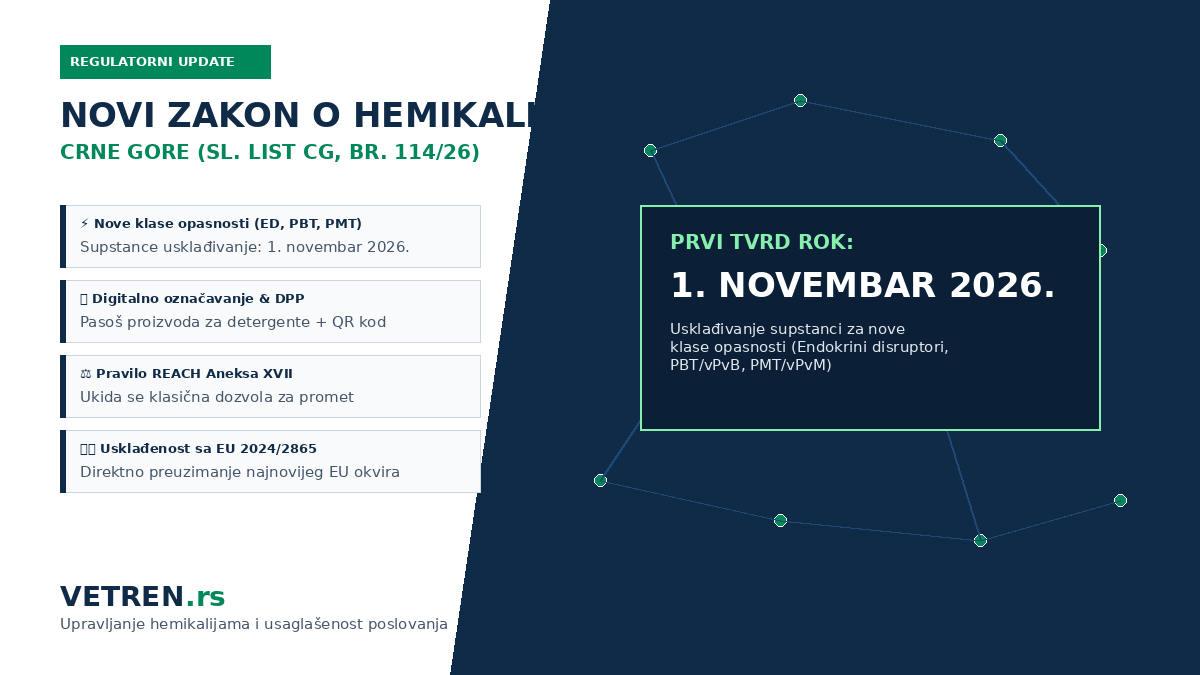
Montenegro's new Law on Chemicals: alignment with the current EU framework
30/08/2026 | By Ivan Milenković
Montenegro’s new Law on Chemicals was published in August 2026 (Official Gazette of Montenegro, No. 114/26). It replaces the 2017 law (Official Gazette of Montenegro, No. 51/17) in its entirety. For practitioners in the region, one fact matters more than the novelty itself: the Montenegrin legislator has transposed the latest generation of EU chemicals legislation into the national framework. Brussels only completed that framework within the past year.
Montenegro’s new Law on Chemicals changes the approach, not just the text
The law was written from scratch rather than as an amendment to the existing one. It entered into force on the eighth day after publication, on August 11, 2026.
Its structure follows the logic of REACH and CLP. The text builds in the precautionary principle and the “no data, no market” rule. The former chapter on the free circulation of dangerous chemicals and the authorisation to place them on the market has been removed entirely. It is replaced by a chapter on restrictions for certain chemicals, following the logic of REACH Annex XVII.
This is not a cosmetic change. It changes how companies classify, label and notify chemicals.
New hazard classes enter the national framework
The biggest change is the introduction of new hazard classes. The law introduces endocrine disruptors for human health and for the environment. It also introduces PBT, vPvB, PMT and vPvM properties as separate classes.
These classes come from the EU framework. Companies that already follow European legislation will recognise them immediately. For everyone else, it means a fresh classification review for part of the portfolio.
Digital labelling comes alongside the new classes. The law allows label elements to also be presented in digital form, as a supplement to the physical label.
Deadlines for Montenegrin companies
The law phases in its obligations. Stock already on the market benefits from transitional periods. The timeline looks like this.
| Obligation | Compliance deadline |
|---|---|
| New hazard classes for substances (endocrine disruptors for human health and for the environment, PBT/vPvB, PMT/vPvM) | November 1, 2026 |
| New hazard classes for mixtures | May 1, 2028 |
| New classification and labelling rules (evaluation of available information, evaluation of substances with more than one constituent, evaluation and classification of mixtures, concentration limits, selection of precautionary statements, labelling exemptions, digital labelling and refill), for stock placed on the market before July 1, 2026 | July 1, 2028 |
| Identification of substances in a mixture, label format, size and layout, rules for digital labels, for stock placed on the market before January 1, 2027 | January 1, 2029 |
Some obligations have no fixed date in the law and instead depend on secondary legislation:
- Secondary legislation, including the rulebook on classification, labelling and packaging, is to be adopted within two years of the law entering into force. Until then, the old regulations continue to apply, insofar as they do not conflict with the new law.
- Notification of hazardous mixtures to the Centre (following the logic of PCN notification) exists as an obligation. The ministry will prescribe the list of mixtures and the electronic format.
- The digital product passport for detergents is introduced by the law. The detailed requirements will follow in a rulebook.
- Stricter advertising requirements (pictograms, EUH statements, a ban on claims such as “eco-friendly” or “non-toxic”, rules for distance selling) apply from the law’s entry into force.
The first hard deadline falls this autumn. Substances with the new hazard classes must be compliant by November 1, 2026. The classification review should start now.
Notification of mixtures, advertising and detergents
The law introduces an obligation to notify hazardous mixtures to the competent Centre. Importers and downstream users submit the data in a prescribed electronic format. The Centre is based at the Clinical Centre of Montenegro. This mirrors the EU system of notifying poison centres.
Advertising requirements have been tightened. Advertisements for hazardous chemicals must include pictograms, signal words and EUH statements. The law explicitly bans claims such as “non-toxic”, “eco-friendly” or “non-polluting” for products classified as hazardous. The same rules apply to distance selling.
Detergents see the biggest change. A detergent may only be placed on the market if it has a digital product passport. The definition of a detergent now also covers products containing microorganisms.
Safety data sheets and Candidate List substances
The obligation to provide a safety data sheet (SDS) has been extended. It now also covers chemicals on the Candidate List of substances of very high concern (SVHC). The law takes that list from the website of the European Chemicals Agency (ECHA).
A new article also gives employees the right to access information from the safety data sheet. Employers must provide that access to workers exposed to chemicals.
For SDS authors, the message is clear: data structure and classification must follow European sources, not local improvisation.
What changes relative to the EU framework
The Montenegrin text follows the revised EU CLP Regulation, Regulation (EU) 2024/2865. The new hazard classes come from Delegated Regulation (EU) 2023/707. At the end of 2025, the EU postponed the application dates to 2028 through Regulation (EU) 2025/2439. Montenegro’s transitional periods follow that revised timeline.
For detergents, the model is the new Regulation (EU) 2026/405. It introduces the digital product passport, rules for microorganisms and stricter biodegradability criteria.
In doing so, Montenegro has adopted rules that were finalised in the EU only a few months ago. That is unusually fast for a national law.
Serbia is on the same path, a step (or two) behind
Serbia is preparing its own new Law on Chemicals. In May 2026, the Ministry of Environmental Protection published the starting points for drafting it. The deadline for written comments was May 27. Part of the draft was presented at a round table at the Serbian Chamber of Commerce at the end of June. The official draft and the public consultation are still to come. Given the situation in parliament and its sitting schedule, the open question is when the law will reach the MPs, and which parliament it will be…
Serbia’s current law was adopted in 2009 and last amended in 2015. The items in the starting points differ somewhat from the Montenegrin ones. They include a chemicals agency, authorisation of substances of concern, the status of the chemicals adviser and a register of intentionally added microplastics. The direction is the same: alignment with the current EU framework.
We covered the Serbian starting points in a separate article, and the obligations for SVHC substances in our analysis of Article 33.
Practical implications for companies
For companies operating across the region, two conclusions are concrete.
First, exporters to the EU have to comply with European requirements right away in any case. For them, the Montenegrin and Serbian deadlines simply confirm the direction of travel.
Second, companies on the Montenegrin market face their first hard deadline this autumn. Preparing the portfolio of safety data sheets and labels for the new hazard classes is no longer something to deal with later.
Whoever aligns their classification early avoids the rush before the deadlines.
Frequently asked questions
When did Montenegro’s new Law on Chemicals enter into force? The law was published in the Official Gazette of Montenegro, No. 114/26. It entered into force on the eighth day after publication, on August 11, 2026.
Which new hazard classes does it introduce? The law introduces endocrine disruptors for human health and for the environment, as well as PBT, vPvB, PMT and vPvM properties.
Is an authorisation to place dangerous chemicals on the market still required? Not in the same way. The former chapter on free circulation and market authorisation has been removed. It is replaced by a system of restrictions for certain chemicals.
What is the digital product passport for detergents? It is a digital record of the product. Under the new law, a detergent may only be placed on the market if it has such a passport.
Does Serbia have a new Law on Chemicals? Not yet. Serbia published the starting points in May 2026, and a working draft was presented at the Chamber of Commerce. The official draft and the public consultation are still to come.
This blog post is for informational purposes only and does not constitute legal advice. For specific situations, consult a licensed chemical adviser or a lawyer specialising in chemical regulation.
← Back to blog