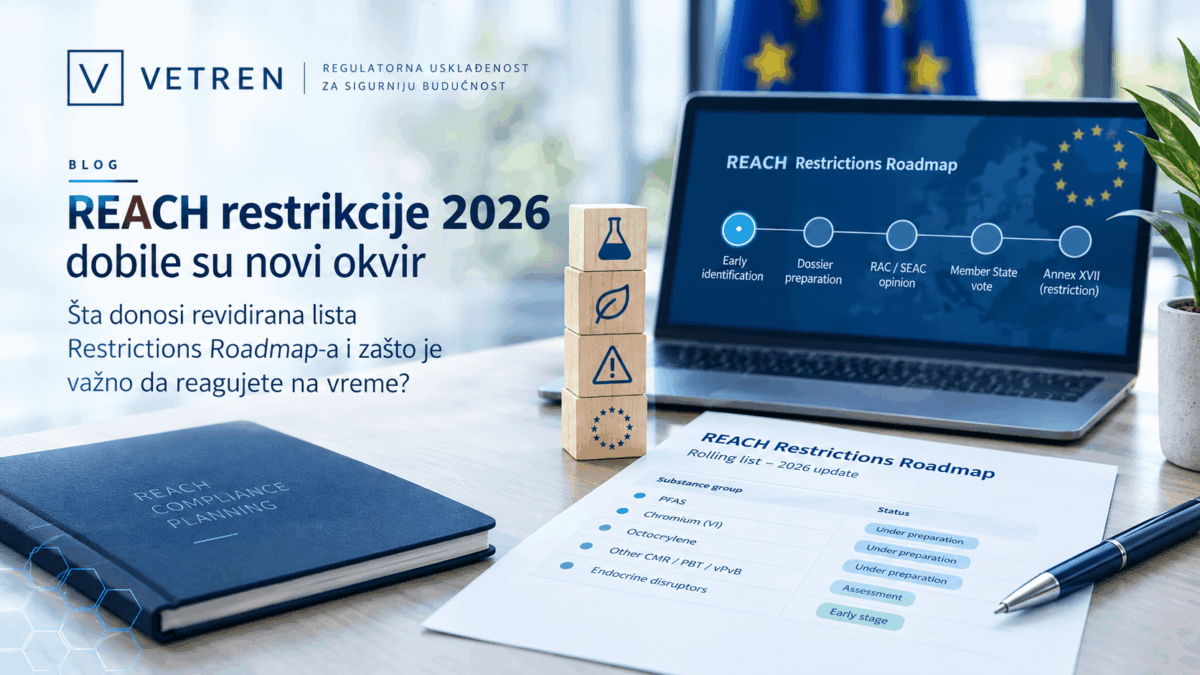
REACH restrictions 2026: the new list and how to prepare in time
13/09/2026 | By Ivan Milenković
REACH restrictions for 2026 have a new framework. On July 2, 2026, the European Commission presented the revised list of its Restrictions Roadmap, the document that announces planned restrictions on hazardous substances. For businesses, timely information about planned restrictions means they can start planning, where needed, how to adapt to a restriction or a ban well before it applies.
That is exactly the point of this document. It does not introduce any new bans by itself. It gives a view of what is coming, while there is still time to react.
What is the Restrictions Roadmap
The Restrictions Roadmap is a planning document the Commission first introduced in 2022, as part of the Chemicals Strategy for Sustainability. Its purpose is transparency: to let industry see in advance which substances and groups of substances are entering the restriction procedure under REACH.
The document’s annex contains a so-called rolling list, which is updated periodically. The list shows substances at different stages of preparation, from early consideration to restrictions that are close to adoption. As a rule, it is updated once a year, following discussion at CARACAL meetings.
One detail is crucial, and it is often misread. The list itself does not ban or restrict any substance. A legal obligation only arises once a formal restriction is entered into Annex XVII of REACH. Until then, the list is an early warning tool, not a legal act.
What is new in the 2026 update
The 2026 revision brings a clearer structure and an overview of progress since 2022. The Commission has added new entries and clearer stages to make tracking easier.
According to the Commission, 11 REACH restrictions covering hundreds of hazardous substances have been adopted since 2022. Six more are in the final stage of assessment. Meanwhile, work continues on major initiatives.
The Commission names its current priorities explicitly: the restriction of PFAS, the so-called “forever chemicals”, followed by hexavalent chromium compounds and octocrylene. Alongside these, the document also tracks other persistent, bioaccumulative and toxic substances, as well as endocrine disruptors.
For companies working with these groups, the message is clear. The time for analysis is now, not when the restriction enters into force.
The stages a substance goes through
The road from the list to a ban takes time, and that is precisely why early warning is valuable. A substance first enters the list at an early stage. Preparation of a restriction dossier follows.
The dossier is then assessed by ECHA’s committees, the Committee for Risk Assessment (RAC) and the Committee for Socio-economic Analysis (SEAC). Only after their opinions and a vote by the Member States is the restriction formally adopted and added to Annex XVII.
The whole process often takes years. That is the window in which a company can respond without rushing. Whoever waits for publication in the Official Journal loses that window.
A substance’s path to a restriction under REACH
The stages in order. A legal obligation only arises at the final stage.
- STAGE 1: Early stage. The substance enters the rolling list and is flagged for consideration.
- STAGE 2: Dossier preparation. The Commission or a Member State prepares a restriction dossier for a specific substance or group.
- STAGE 3: Assessment by ECHA committees. RAC and SEAC assess the dossier, with public consultation of interested parties.
- STAGE 4: Decision. Based on the committees’ opinions, the Member States vote on the proposed restriction.
- STAGE 5: Annex XVII. The restriction is adopted and entered into Annex XVII. Only then does it become a legal obligation, with transitional periods.
STAGES 1–4: Preparation window: time to review your portfolio and, where needed, start planning how to adapt.
STAGE 5: Obligation in force
Note: the overall duration of the process varies and is often measured in years. The rolling list does not introduce a ban by itself; it gives an early warning about substances in the procedure.
Source: European Commission and ECHA (REACH restriction procedure).
The REACH revision has stalled, restrictions continue
The wider context matters here. The major revision of REACH, announced for years, has officially been put on hold. On April 27, 2026, Environment Commissioner Jessica Roswall told the ENVI Committee that the Commission will not reopen REACH for now.
That does not mean things are going quiet. Quite the opposite. With no major reform, restrictions continue through the existing mechanism, that is, through Annex XVII. This makes the Restrictions Roadmap all the more important. It is now the main radar for what is coming.
Impact on businesses in Serbia
Serbia aligns its chemicals legislation with the EU framework. What appears on an EU list today becomes part of a domestic obligation, or a condition for export, tomorrow.
Exporters feel this first. Customers and partners in the EU are already asking for products that comply with the latest restrictions. The pressure comes through the supply chain as well, not only through regulation. A company that follows the rolling list finds it easier to hold its position in the market.
How to respond in time
The practical approach is simple, but it requires consistency. The following steps help turn early information into a concrete advantage:
- Build an up-to-date overview of the substances and mixtures in your portfolio.
- Compare that overview with the current priorities, above all PFAS, hexavalent chromium and octocrylene.
- Flag the products that contain substances from the early stages of the list.
- Revise the safety data sheets for those products (where needed) and check their classification.
- Assess substitution options early, while there is still time to test alternatives.
- Set up regular monitoring of sources, from ECHA and the Commission to the Serbian rulebook on restrictions and bans.
This sequence turns uncertainty into a plan. The result is less risk, lower costs and a more stable supply chain.
Frequently asked questions
What is the REACH Restrictions Roadmap? It is a European Commission planning document that announces restrictions on hazardous substances under REACH. It was introduced in 2022 and gives industry insight into future restrictions.
Is a substance on the list automatically banned? No. The list is an early warning tool. A legal obligation only arises once the restriction is formally entered into Annex XVII of REACH.
When was the 2026 list presented? The European Commission presented the revised list on July 2, 2026, following discussion at the 58th CARACAL meeting held on July 1 and 2, 2026.
Which substances are currently a priority? The Commission explicitly names PFAS, hexavalent chromium compounds and octocrylene, along with other persistent, bioaccumulative, toxic and endocrine-active substances.
What is the difference between the Restrictions Roadmap and the SVHC Candidate List? The SVHC Candidate List identifies substances of very high concern and triggers notification obligations. The Restrictions Roadmap is an earlier-stage planning tool that tracks substances on their way to a restriction under Annex XVII.
Is REACH changing? The major revision was put on hold in April 2026. Restrictions, however, continue through the existing mechanism, so monitoring remains just as important.
This blog post is for informational purposes only and does not constitute legal advice. For specific situations, consult a licensed chemical adviser or a lawyer specialising in chemical regulation.
← Back to blog